How to Choose the Right Cobot Robot for Your Business?
In today's rapidly evolving manufacturing landscape, selecting the right cobot robot can significantly impact your business's efficiency and productivity. According to a recent report by the International Federation of Robotics, the cobot market is projected to reach $9 billion by 2025. This growth reflects a growing trend among diverse industries. Notably, manufacturers seek automation solutions that enhance workplace safety and operational flexibility.
Dr. Sarah Mitchell, a leading expert in robotics, emphasizes, "Choosing the right cobot for your operations is not just about technology; it’s about understanding your specific needs." This statement underscores the importance of aligning cobot capabilities with your business processes. Each cobot possesses unique features, affecting how it can be integrated into different workflows.
However, the selection process is often imperfect. Many businesses may underestimate the importance of training and support in cobot implementation. Some firms rush into purchases without a clear strategy. This approach can lead to suboptimal utilization, highlighting the need for thorough research and expert guidance in selecting the right cobot robot.

Understanding Cobot Robots: Definition and Applications
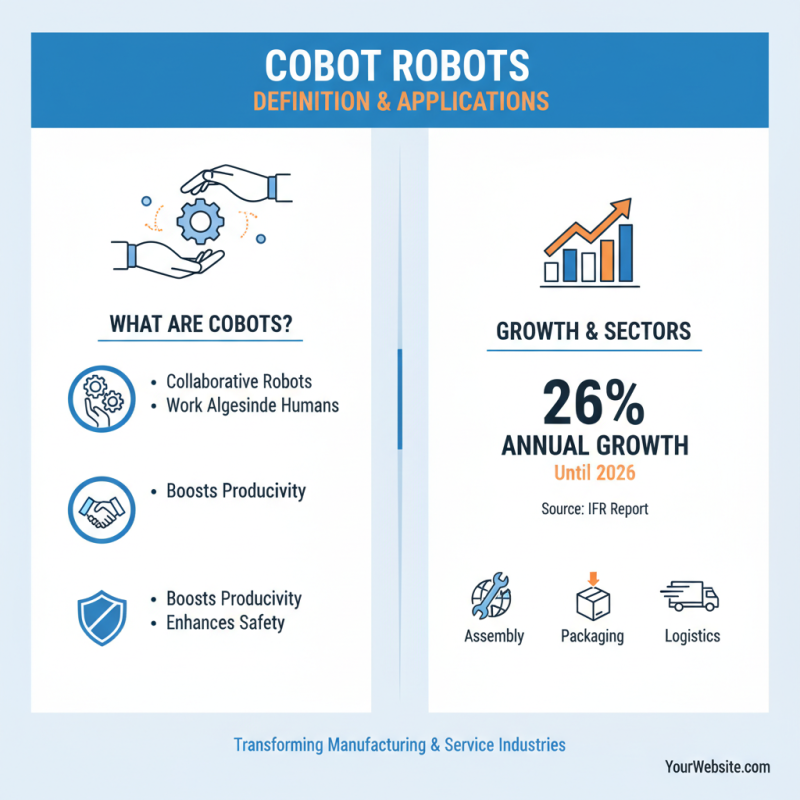
Cobot robots, or collaborative robots, are transforming the landscape of manufacturing and service industries. These robots work alongside human operators, enhancing productivity and safety. According to a recent report by the International Federation of Robotics, the global market for cobots is projected to grow at a rate of 26% per year until 2026. This rapid growth reflects a shift towards automation in various sectors, including assembly, packaging, and logistics.
In practical applications, cobots are used for tasks that require precision and repeatability. They assist in activities like quality control and machine tending. A study from Deloitte revealed that companies integrating cobots saw an average efficiency increase of 35%. These machines are designed with safety features, allowing them to operate in close proximity to people. However, businesses must assess their specific needs before investment. Understanding the work environment and the tasks cobots will assist with is crucial for maximizing their benefits.
Despite their advantages, it’s important to note some challenges. Compatibility with existing systems can be an issue. Not all cobots interface seamlessly with older machinery. Moreover, training staff to work effectively with these robots requires time and resources. Organizations should weigh these considerations carefully, as a poor integration could lead to setbacks rather than advancements.
Evaluating Your Business Needs: Assessing Tasks for Automation
When considering cobot robots for your business, evaluating your automation needs is crucial. According to a report by the International Federation of Robotics, collaborative robots are expected to grow by over 30% annually through 2025. This data suggests that many companies are recognizing the benefits of automation. However, it also means that a one-size-fits-all approach may not be effective.
Start by assessing which tasks could benefit from automation. Research shows that repetitive and mundane tasks account for nearly 60% of industrial workers' time. Common examples include material handling, assembly, and quality inspection. These processes can often be streamlined with the right cobot. It's important to also identify tasks that require human judgment or decision-making, as these may not be suitable for automation.
Another factor to consider is the collaborative aspect of cobots. A 2022 study highlighted that 72% of businesses felt that integrating robots improved employee satisfaction. However, employee readiness and training are often overlooked. Involving team members in the transition can lead to smoother implementation and better results. Ultimately, the choice of cobot should align not only with operational needs but also with workforce dynamics. Be prepared to reassess and adapt as your business evolves.
Key Features to Consider When Selecting a Cobot Robot
When choosing a cobot robot, several key features play an essential role in the decision-making process. The first aspect to consider is payload capacity. Understand how much weight your cobot needs to handle. Assess your specific tasks. This ensures optimal performance.
Another vital feature is the robot's reach. Evaluate the working area and height. A cobot with limited reach may hinder productivity. Therefore, consider the layout of your workspace. Flexibility is crucial too. Look for a robot that can be easily reprogrammed for different tasks. This adaptability can save time and resources.
Tips: Pay attention to safety features, such as sensors and emergency stops. These ensure a secure work environment. Additionally, assess the ease of integration. Can the cobot connect with existing systems? Compatibility reduces downtime. Investing time in these considerations can prevent future regrets.
How to Choose the Right Cobot Robot for Your Business?
| Feature |
Description |
Importance |
| Payload Capacity |
The maximum weight the robot can handle. |
Crucial for determining the tasks the robot can perform. |
| Reach |
The distance the robot's arm can extend from its base. |
Important for workspace design and task execution. |
| Safety Features |
Includes sensors and software that allow safe interaction with humans. |
Essential for compliance with safety standards. |
| Ease of Programming |
How easily operators can program and control the robot. |
Affects training time and operational efficiency. |
| Mobility |
The ability of the robot to move within the workspace. |
Influences flexibility in task deployment. |
| Integration Capabilities |
Compatibility with existing systems and technology. |
Critical for maximizing investment and efficiency. |
| Maintenance Requirements |
Frequency and type of maintenance needed to keep the robot operational. |
Impacts long-term operational costs and uptime. |
Comparing Different Cobot Manufacturers and Models
When selecting a cobot, it's crucial to compare various manufacturers and their offerings. Manufacturers may differ significantly in terms of features, payload capacity, and ease of integration. Assessing each model's unique specifications is a foundational step. For instance, some cobots excel in tasks requiring dexterity, while others may focus on heavier loads. Identification of your business needs can clarify which models fit best.
Another aspect to consider is the support and training provided by manufacturers. Effective training can impact the successful implementation of a cobot. Some brands have extensive customer service networks, while others may offer limited support. Understanding the warranty and service options is vital. This strategy ensures that you receive prompt assistance, minimizing downtime in your operations.
Beware of shiny marketing claims. Not all cobots live up to expectations. Feedback from current users can offer a realistic view of reliability and performance. Some cobots may show frequent issues in real-world applications. Investigating peer reviews and case studies can offer valuable insights. It's essential to weigh both positive and negative experiences before making a decision.
Budgeting for Your Cobot Investment: Cost vs. Benefit Analysis
When considering the investment in collaborative robots, or cobots, a thorough cost versus benefit analysis is crucial. In 2021, a report by the International Federation of Robotics indicated that the global market for cobots is expected to reach $12 billion by 2025. This rapid growth highlights the increasing adoption of cobots in various industries. Businesses must analyze upfront costs, including purchase price, installation, and maintenance. The average cost of a cobot ranges between $20,000 and $40,000, depending on its capabilities and features.
On the benefit side, cobots can enhance productivity and efficiency. According to a study conducted by McKinsey, companies that implemented cobots saw productivity improvements of 30% on average. This means cobots can facilitate repetitive tasks, allowing human workers to focus on more complex duties. However, businesses should also consider training costs for operators. Not every organization has skilled personnel ready for this technology, which can add to initial expenditures.
It’s important to reflect on whether the investment aligns with your business goals. Some companies report challenges in integrating cobots into existing workflows. This can create disruption and may lead to underutilization of the robot's capabilities. Balancing upfront costs with potential gains requires careful planning. A well-executed strategy can transform productivity, yet misalignment can lead to wasted resources and missed opportunities.