
How to Choose the Best Lab Robotics for Your Needs?
Choosing the right lab robotics can significantly impact your research and productivity. With various options available, it's essential to assess your specific needs. Lab robotics can streamline repetitive tasks, enhance accuracy, and save time in various laboratory settings.
Understanding your lab's requirements is crucial. Are you focusing on high-throughput screening, sample handling, or data analysis? Each application might require different features and capabilities in your robotic systems.
It's not just about technology. You must consider factors like usability, support, and integration with existing systems. Evaluate the vendor's experience and expertise in lab robotics. This can ensure you get a reliable solution that meets your goals. Choosing lab robotics is not merely a technical decision but a strategic one that can shape your research future.

Understanding Your Laboratory Requirements for Robotics
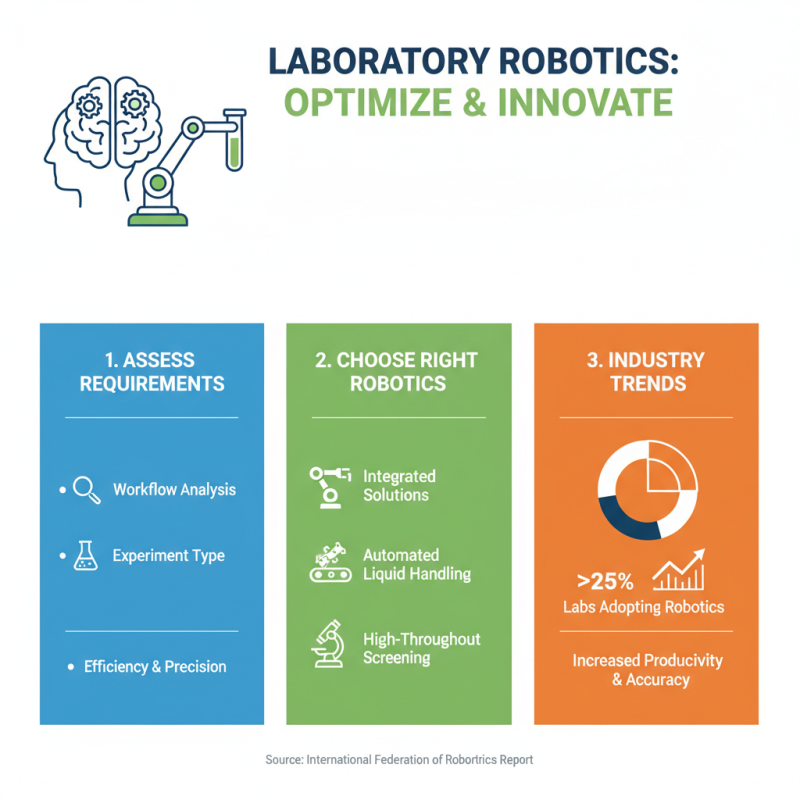
Choosing the right lab robotics is crucial for optimizing workflow and enhancing productivity. Understanding your laboratory's unique requirements is the first step. A recent report from the International Federation of Robots indicates that over 25% of laboratories are now integrating robotic solutions. This shift is largely due to the desire for increased efficiency and precision in experiments.
Consider the types of tasks your laboratory performs. Are you focused on liquid handling, high-throughput screening, or sample preparation? Each task requires specific robotic features. For instance, systems designed for liquid handling typically need high accuracy and flexibility to manage a variety of sample types. The Lab Automation Market report highlights that 70% of lab managers feel automation has improved their experiment reproducibility, yet many struggle with selecting the right technology.
Assessing your current processes is essential. Evaluate areas where delays occur or mistakes are frequent. Robotics can help mitigate these challenges, but over-reliance can be problematic. Research shows that 40% of robotics implementations face user resistance. It’s vital to select technology that complements your team’s skills. Striking a balance between automation and human expertise is necessary for successful integration.

Key Features to Consider in Lab Robotics
When selecting lab robotics, key features should guide your decision. One critical aspect is precision. High accuracy in liquid handling and sample processing enhances your experimental outcomes. Look for robotics that can minimize errors, ensuring your results are reliable. This is crucial, especially when dealing with sensitive experiments.
Another essential feature is flexibility. A versatile robotic system can adapt to various tasks, from sample preparation to data analysis. Consider a unit that can easily integrate new tools as laboratory needs evolve. The ability to customize settings for specific protocols can save time and reduce repetitive tasks.
Additionally, ease of use should not be overlooked. A user-friendly interface allows for quick training and minimizes mistakes. If the system requires extensive training, productivity may drop initially. Always assess the level of support available for troubleshooting. Having robust documentation and responsive technical assistance can significantly enhance your team's confidence in using the equipment. This all contributes to optimizing lab workflow and efficiency over time.
Types of Lab Robotics and Their Applications
When considering lab robotics, it’s essential to explore the various types available. One common form is the robotic arm, designed for tasks like pipetting or assembly. These robots can increase precision and efficiency, reducing the risk of human error. They are ideal for repetitive actions, allowing human researchers to focus on complex activities. However, these systems may require significant upfront investment and training.
Another type is autonomous mobile robots. These robots navigate laboratory spaces to transport samples or equipment. They save time and minimize the need for manual transport. Many users find these devices enhance lab workflow, but their initial programming can be challenging. Users must ensure they are programmed correctly to prevent mishaps.
The third type is specialized robotic systems. These can perform a variety of laboratory applications, from high-throughput screening to automated analysis. They are vital in research facilities aiming for high productivity. The complexity of these systems can be daunting, and selecting the appropriate one may require detailed assessments. A mismatch can lead to inefficiencies or unintended consequences in data collection.
Selecting the right type of lab robotics requires careful evaluation of needs and capabilities. Understanding each type’s strengths and weaknesses can help researchers make informed decisions.
How to Choose the Best Lab Robotics for Your Needs? - Types of Lab Robotics and Their Applications
| Type of Lab Robotics | Application | Advantages | Considerations |
|---|---|---|---|
| Liquid Handling Robots | Sample preparation, drug discovery | High precision, increased throughput | Cost, training needed |
| Automated Pipetting Systems | Biochemical assays, diagnostics | Consistency, reduces human error | Space requirements, compatibility |
| Sample Management Systems | Storage and retrieval of samples | Efficient inventory management | Implementation time, maintenance |
| Analyzers and Process Automation | Quality control, environmental testing | Fast analysis, real-time monitoring | Initial setup costs, training required |
| Robotic Arms | Mating, assembly, and testing | Versatility, programmable tasks | Complex programming, safety concerns |
Evaluating Budget and Cost-Benefit Analysis
When evaluating the budget for lab robotics, it’s important to consider all costs involved. The initial purchase price is just the starting point. You should also assess operational and maintenance costs. These costs can impact your budget greatly over time. Calculating the total cost of ownership can provide clearer insights into your investment.
Tips: Create a spreadsheet to track all expenses. This will help visualize potential costs.
Besides costs, consider the potential benefits. Successful automation can lead to increased productivity, improved accuracy, and reduced human error. However, not every robot will meet your unique needs. Some may not deliver a good return on investment. It is vital to evaluate how the robotics will integrate into your current processes. This requires a thoughtful analysis of both short-term and long-term goals.
Tips: Collect feedback from users of similar systems. Their insights can guide your decision-making process.
Cost-Benefit Analysis of Lab Robotics Solutions
This chart shows a comparison of different lab robotics solutions based on their initial cost, expected annual maintenance cost, and estimated productivity gain over a five-year period.
Future Trends in Lab Robotics Technology
The landscape of lab robotics is evolving rapidly. New technologies enhance efficiency and precision in laboratory settings. Automation not only reduces human error, but also accelerates research processes. This shift is crucial as laboratories face increasing demands for speed and accuracy.
The integration of artificial intelligence with robotics now allows for smarter, more adaptive workflows.
However, these advancements present challenges. Not all labs can easily implement complex systems. Adapting to evolving technologies requires training and investment. Moreover, there’s a risk of over-reliance on automation. Scientists must still engage in critical thinking and problem-solving. Balancing automation with human insight is essential for successful lab operations.
As we look ahead, personalization in lab robotics is gaining traction. Customization will allow for tailored solutions to meet unique research needs. This trend indicates a shift towards more user-friendly interfaces.
However, with these innovations, ethical considerations arise. Privacy, security, and data integrity are vital concerns. Labs must navigate these issues thoughtfully.
Related Posts
-
Revolutionizing Research Efficiency through Lab Robotics and Automated Workflows in Life Sciences
-

Top Lab Robotics Innovations Transforming Scientific Research?
-

Revolutionizing Research: The Impact of Lab Robotics on Scientific Discoveries
-
Why Is Laboratory Robotics Essential for Modern Research?
-

2026 Best Laboratory Robotics Innovations and Trends?
-

Top Trends in Laboratory Robotics for 2026 What to Expect