China Top Wheel Motor Manufacturers How to Choose?
Choosing among China’s top Wheel Motor manufacturers requires more than comparing catalog prices. A reliable Wheel Motor must match the vehicle’s load, speed, voltage, terrain, and duty cycle. A compact warehouse vehicle needs different performance than a mining transporter. The details matter.
Experienced buyers usually examine torque curves, thermal limits, sealing performance, brake integration, and controller compatibility. Ask for test data, not only polished specifications. Check whether the manufacturer performs endurance testing under realistic loads. A motor that survives a short demonstration may still overheat after hours of continuous operation. That difference can affect safety, maintenance costs, and delivery schedules.
Factory evaluation also deserves attention. Review machining equipment, winding processes, quality records, and production traceability. Request samples before placing a large order. Measure noise, vibration, temperature rise, and efficiency during testing. Confirm certifications and documentation for your target market. After-sales support matters too. Spare parts, technical drawings, response times, and warranty terms reveal a supplier’s reliability.
Do not trust rankings alone. Some “top” manufacturers may suit one application but fail another. This is where careful comparison becomes necessary. An honest selection process should include a technical meeting, factory verification, and independent performance checks. Mistakes can still happen. Even experienced teams may overlook software integration or installation space. The best choice is not always the cheapest offer. It is the manufacturer that provides consistent quality, clear evidence, practical support, and a Wheel Motor designed for your actual working conditions.
What Is a Wheel Motor and How Does It Work?
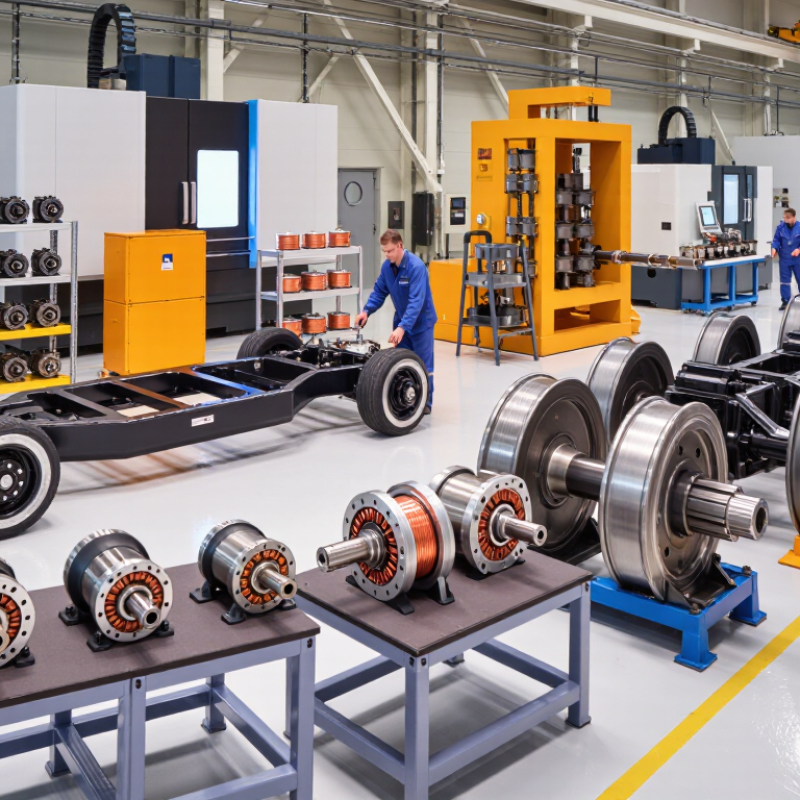
A wheel motor places the motor inside, or beside, a vehicle wheel. Unlike a central motor, it can drive the wheel directly through electromagnetic force. The stator remains fixed, while the rotor turns with the wheel. Permanent magnets create rotation when controlled current reaches the windings. The controller adjusts current according to throttle input, speed, and load. Hall sensors may report rotor position for smoother starting. Simple in theory. Real systems are less forgiving.
During operation, torque moves the wheel from rest, while heat builds inside the compact housing. Good designs use aluminum housings, sealed bearings, and effective heat paths. Check the rated voltage, continuous torque, peak torque, and thermal limits. A motor that looks powerful on paper may overheat on a long slope. When choosing a Chinese wheel motor manufacturer, request load-test records, insulation data, water-resistance ratings, and sample inspection results. Ask how the motor performs after repeated acceleration, not only during one demonstration. I have seen specifications hide practical weaknesses.
Tips: Match the motor to wheel size, vehicle weight, and controller limits. Confirm axle dimensions before ordering. Check cable protection near moving parts. Request a sample unit and measure temperature after real use. Do not judge quality by weight alone. Cost matters, but repair access matters too.
Key Types of Wheel Motors Used in China
China Top Wheel Motor Manufacturers: How to Choose?
Key Types of Wheel Motors Used in China
China’s wheel motor market serves electric bicycles, scooters, delivery carts, and compact industrial vehicles. The most common options are geared hub motors, direct-drive hub motors, and high-torque low-speed motors.
Geared hub motors use internal reduction gears to increase starting torque. They are light, compact, and suitable for city riding, ramps, and frequent stops. Direct-drive motors have fewer moving parts and support quiet operation. They work well on larger scooters and vehicles requiring steady speed, regenerative braking, or longer service life. However, they can feel heavy during installation.
High-torque low-speed motors are useful for cargo tricycles, warehouse carts, and small utility vehicles. Their winding design favors pulling power rather than maximum speed. Some Chinese manufacturers also produce brushless permanent-magnet motors with integrated controllers. This arrangement saves space, but controller heat may become a problem inside a sealed wheel.
Choose by application, not advertising.
Check the torque curve, rated power, peak current, wheel diameter, and thermal rise. A motor that performs well on a test bench may struggle on a hot road with a heavy load. In factory evaluations, inspect waterproofing, axle strength, bearing quality, cable protection, and repeated hill-start results. IP ratings help, but poor cable sealing can still cause failures.
I have seen buyers focus too much on wattage. That is a mistake. Battery voltage, controller settings, tire size, and vehicle weight change the real performance. No selection is perfect. A sample test under actual load remains more reliable than a polished specification sheet.
China Top Wheel Motor Manufacturers How to Choose? - Key Types of Wheel Motors Used in China
| Wheel Motor Type | Typical Chinese Application | Motor Construction | Typical Rated Voltage | Typical Power Range | Typical Torque / Speed Characteristics | Main Advantages | Main Limitations | Key Selection Criteria |
|---|---|---|---|---|---|---|---|---|
| Geared Hub Motor | Electric bicycles, shared bicycles, scooters, and light delivery vehicles | A high-speed brushless motor connected to the wheel through a planetary reduction gear | 24–48 V DC | 180–1,000 W continuous; higher peak output is possible | High starting torque; commonly designed for low to medium vehicle speeds | Compact size, low weight, strong hill-start performance, and good efficiency at low speed | Gear noise, mechanical wear, and possible freewheel losses during regeneration | Required climbing grade, wheel diameter, gear durability, noise level, waterproofing, and service life |
| Direct-Drive Hub Motor | Electric bicycles, scooters, utility tricycles, and low-speed electric vehicles | Large-diameter outer-rotor permanent-magnet motor with the wheel directly attached to the rotor | 36–96 V DC | 350 W–5 kW continuous, depending on vehicle class | High low-speed torque; efficient cruising and capable of regenerative braking | Quiet operation, simple mechanical structure, low maintenance, and reliable regeneration | Higher unsprung mass, larger diameter, and weaker hill performance for the same rated power than a geared design | Wheel size, peak torque, thermal dissipation, vehicle mass, axle strength, and regenerative-braking requirements |
| High-Torque Low-Speed Hub Motor | Electric tricycles, compact cargo vehicles, mobility vehicles, and warehouse carts | Large-pole-count permanent-magnet motor optimized for frequent starts and low vehicle speed | 48–120 V DC | 1–10 kW continuous; short-duration peak power may be substantially higher | High continuous torque at low wheel speed; usually limited top speed | Good load-starting capability, stable control, and suitability for stop-and-go operation | Heavy wheel assembly, increased heat at low-speed overload, and greater demand on the axle and bearings | Gross vehicle weight, maximum grade, start frequency, continuous torque, cooling method, and axle load rating |
| Permanent-Magnet Synchronous Wheel Motor | Passenger electric vehicles, electric buses, and higher-performance commercial vehicles | Permanent-magnet synchronous machine using an inverter for field-oriented control | 200–800 V DC bus systems | 10–100 kW per wheel in specialized or high-performance vehicle designs | High power density, precise torque control, and a broad operating-speed range with field weakening | High efficiency, compact drivetrain layout, rapid response, and potential for independent wheel control | Higher cost, complex inverter and software requirements, magnet temperature sensitivity, and increased unsprung mass | Peak and continuous power, cooling circuit, inverter compatibility, control software, safety architecture, and EMC performance |
| Brushless DC Hub Motor | Electric bicycles, scooters, small carts, and compact automated vehicles | Permanent-magnet rotor and electronically commutated stator, commonly controlled with Hall sensors or sensorless algorithms | 24–72 V DC | 100 W–3 kW continuous | Good low-speed torque and simple speed control; characteristics depend strongly on winding and controller settings | Low maintenance, good efficiency, simple electronic control, and broad availability of compatible controllers | Torque ripple may be noticeable; Hall sensors, connectors, and controller calibration can affect reliability | Hall-sensor arrangement, controller protocol, phase current, starting behavior, noise, and connector protection |
| Integrated Electric Axle with Wheel-End Motor | Light commercial vehicles, logistics vans, electric buses, and specialty utility vehicles | Motor, reduction gear, differential or drive unit, inverter, and wheel-end components integrated into an axle assembly | 200–800 V DC bus systems | 30–250 kW per axle, depending on vehicle size and duty cycle | High continuous torque with optimized reduction ratio and controlled regenerative braking | Simplifies vehicle packaging, reduces mechanical drivetrain parts, and supports scalable vehicle platforms | Higher system cost, significant assembly weight, and more demanding thermal, electrical, and service integration | Axle rating, duty cycle, reduction ratio, cooling interface, CAN communication, braking coordination, and maintainability |
| AGV / AMR Wheel Module | Factory automated guided vehicles, autonomous mobile robots, hospital robots, and warehouse equipment | Compact geared motor or direct-drive motor combined with wheel, encoder, brake, and steering or suspension elements | 24–48 V DC | 100 W–3 kW continuous per drive wheel | Low-speed precision control, high positioning accuracy, and frequent acceleration and deceleration | Compact installation, accurate feedback, programmable motion control, and easy integration with vehicle networks | Limited outdoor environmental tolerance in some designs, sensitivity to floor shock, and strict encoder reliability requirements | Load per wheel, floor condition, positioning accuracy, encoder resolution, emergency brake, communication protocol, and duty cycle |
| Hydraulic Wheel Motor | Construction machinery, agricultural equipment, compact loaders, and off-road vehicles | Hydraulic orbital, radial-piston, or axial-piston motor mounted at or near the wheel hub | Hydraulic systems commonly operate at approximately 100–350 bar | Output is specified by displacement and pressure; power commonly ranges from several kilowatts to over 100 kW | Very high starting torque and low-speed pulling capability; speed varies with oil flow | Excellent overload tolerance, robust off-road performance, and flexible hydraulic-system integration | Lower overall efficiency than a well-matched electric system, hydraulic heat generation, leakage risk, and regular fluid maintenance | Displacement, continuous pressure, peak pressure, oil flow, brake integration, case drainage, sealing, and contamination control |
Note: The specifications shown are typical engineering ranges for products used in China and are not universal ratings. Actual performance depends on wheel diameter, vehicle mass, battery voltage, controller calibration, cooling method, duty cycle, road conditions, and applicable safety requirements.
How to Evaluate China’s Wheel Motor Manufacturers
China’s wheel motor sector is expanding with the wider new-energy vehicle market. The China Association of Automobile Manufacturers reported 12.87 million new-energy vehicle sales in 2024. The International Energy Agency also recorded more than 17 million electric car sales worldwide that year. These figures show demand, not manufacturing quality. Numbers need context.
Ask manufacturers for measured torque, continuous power, efficiency maps, thermal limits, and water-ingress test results. Compare identical test conditions, including voltage, temperature, load, and cooling method. A reliable supplier should provide traceable production records and repeatable end-of-line testing. Check quality systems such as ISO 9001 and IATF 16949, but do not treat certificates as proof of performance. Visit the factory. Observe winding inspection, rotor balancing, sealing, and final motor testing.
Examine field experience through failure-rate data, warranty claims, spare-parts planning, and documented corrective actions. The motor must suit your vehicle’s axle load, suspension design, brake system, and road environment. Request samples before signing volume contracts. Independent testing is valuable for noise, vibration, durability, insulation, and electromagnetic compatibility. Some suppliers present impressive peak torque figures while hiding short duty cycles. That deserves careful questioning. Industry reports often combine different vehicle categories, so market growth cannot replace technical due diligence. A supplier may appear strong on paper yet lack stable process control.
Essential Technical and Quality Factors to Compare
China Top Wheel Motor Manufacturers: How to Choose?
Technical performance should lead the comparison, not the catalogue price. The IEA Global EV Outlook 2024 reports nearly 14 million electric cars were sold worldwide in 2023. That growth increases pressure on motor reliability and production consistency. Check the motor’s continuous torque, peak torque, efficiency map, cooling method, and torque ripple. A high peak figure may impress, but continuous output matters more during long climbs. In-wheel motors also add unsprung mass. Therefore, suspension testing is essential.
Ask manufacturers for independent dynamometer results, thermal-cycle records, vibration data, and water-ingress testing. IEC 60529 ratings can clarify enclosure protection, but an IP rating alone proves little about real road durability. Review magnet retention, bearing life, insulation resistance, regenerative braking control, and electromagnetic compatibility. ISO 9001 or IATF 16949 systems can support process control, yet certificates cannot replace production evidence. Traceable serial numbers and end-of-line testing reveal more.
Tips: Request test conditions, not only final numbers. Compare results at identical voltage, temperature, and speed. Inspect a sample after endurance testing. Ask how failures are recorded and corrected. A supplier avoiding difficult questions deserves caution. Perfect laboratory data still cannot reproduce every pothole, winter road, or overloaded vehicle. That limitation should remain part of your purchasing decision.
How to Select the Right Manufacturer for Your Needs
Choosing a wheel motor manufacturer in China requires more than comparing prices. Start by defining your vehicle’s load, wheel size, speed, gradient, duty cycle, and operating temperature. A suitable manufacturer should explain torque curves, rated power, efficiency, braking options, and controller compatibility clearly. Vague specifications are warning signs.
Tips: Ask for test reports, sample data, production photos, and quality certificates. Check whether the factory performs winding, assembly, sealing, and end-of-line testing internally. Request a sample before placing a large order. Measure noise, heat, vibration, starting torque, and energy use under realistic loads. Confirm service response times and spare-part availability in writing.
A reliable supplier should also understand your market’s safety and electromagnetic compatibility requirements. Ask how the motor handles water, dust, corrosion, and repeated braking. Review tolerances for shafts, bearings, connectors, and mounting holes. These small details can stop an expensive redesign. A low quotation may seem attractive, but weak sealing or inconsistent magnets can raise lifetime costs. Do not rely only on polished brochures. Factory audits and traceable inspection records reveal more. Even experienced buyers can overlook controller matching, and that mistake may appear only after installation. Choose a manufacturer willing to discuss limitations, not one promising perfection.