Why Is Laboratory Robotics Essential for Modern Research?
In the rapidly evolving landscape of scientific research, laboratory robotics is becoming indispensable. According to a recent report by MarketsandMarkets, the laboratory robotics market is expected to reach over $6 billion by 2025. This significant growth highlights the essential role that automation plays in enhancing research efficiency and accuracy.
Dr. Elizabeth Adams, a leading expert in laboratory automation, stated, "Laboratory robotics streamline workflows and reduce human error, allowing for more reliable data collection." Robots can perform repetitive tasks faster and with greater precision than human hands, freeing researchers to focus on more complex problems. Yet, there remains a critical conversation about balancing technology with human oversight. While robotics offers many advantages, researchers must continuously assess how much autonomy should be given to machines.
The path forward is not without challenges. The integration of laboratory robotics requires substantial investment and training. Only a percentage of labs are fully utilizing these technologies to their potential. Effective collaboration between humans and robots is essential for realizing the full benefits of laboratory robotics.

The Evolution of Laboratory Robotics in Scientific Research
The evolution of laboratory robotics has transformed the landscape of scientific research. Initially, robotic systems were rudimentary. They mostly performed repetitive tasks with limited precision. Over time, advancements in technology led to more sophisticated designs. Robots can now handle complex experiments autonomously with high accuracy.
These robotic systems have enhanced productivity significantly. Researchers can focus on critical thinking and data analysis. Despite these advances, challenges remain. Integration with existing workflows can be difficult. Some researchers express concerns about reliance on technology. They worry that human intuition may be overlooked. Robotics should complement human skills, not replace them.
Modern robotic platforms now offer greater flexibility. They can adapt to various tasks across disciplines. These systems also allow for high-throughput screening in drug discovery and genomics. However, the cost of implementing such technology can be high. Smaller labs may struggle to keep up. Continuous evaluation and improvement are essential in this evolving field.
Why Is Laboratory Robotics Essential for Modern Research?
| Dimension |
Description |
Impact on Research |
| Automation |
Utilization of robotic systems to perform repetitive tasks with minimal human intervention. |
Increases efficiency and accuracy, reducing human error in experiments. |
| High Throughput Screening |
Allows for the rapid testing of multiple samples simultaneously. |
Accelerates drug discovery and genomics research. |
| Data Management |
Integration of robotic systems with software for data analysis and management. |
Enhances data accuracy and facilitates comprehensive analysis. |
| Miniaturization |
Development of smaller robotic systems that consume less space and resources. |
Promotes innovative research methods and reduces operational costs. |
| Remote Operation |
Ability to control robotic systems via the internet or remote interfaces. |
Enables research to continue without physical presence in the lab. |
Key Advantages of Implementing Robotics in Laboratory Settings
Laboratory robotics is transforming modern research in many significant ways. One of the key advantages is efficiency. Robots can perform repetitive tasks with precision and speed. This allows researchers to focus on complex analysis. Imagine a robotic arm handling thousands of samples a day, reducing human error. These machines never tire or lose concentration.
Another essential benefit is consistency. Robots deliver standardized results across experiments. This uniformity is crucial for valid comparisons and reproducibility in research. However, reliance on robots can lead to overconfidence. Researchers may overlook the need for human oversight. It is vital to balance automation with human expertise to ensure quality results.
Cost-effectiveness is another advantage. Although initial investment may be high, the long-term savings are significant. Fewer errors mean reduced waste of materials. Better resource management leads to optimal budget use. Yet, the shift to robotics requires adaptation and training. Staff must learn new skills to work alongside these technologies. This transition can be challenging but necessary for progress in the field.
Applications of Laboratory Robotics Across Various Scientific Fields
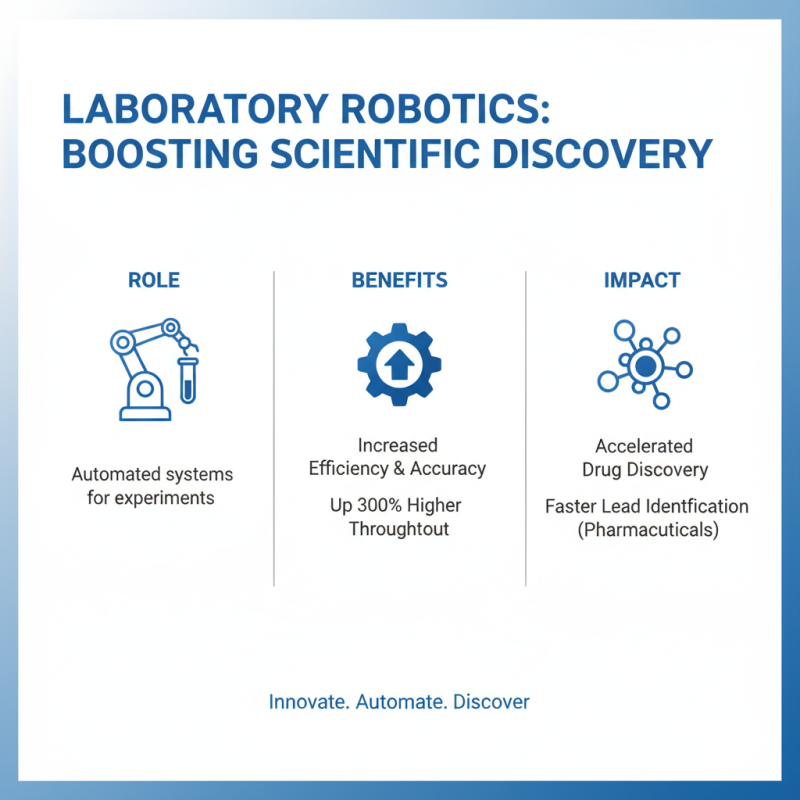
Laboratory robotics plays a vital role across various scientific fields. These automated systems enhance efficiency and accuracy in experiments. For instance, a recent study reported that robotic systems can increase throughput by up to 300% in high-throughput screening processes. This is especially beneficial in pharmaceuticals, where lead identification can take years without automation.
In biology, lab robots handle repetitive tasks, like pipetting and sample processing. They reduce human error significantly. According to a 2022 industry report, labs using automation saw a 25% reduction in experimental variabilities. However, there are challenges. The initial investment for robotic systems can be high. Smaller labs often struggle with costs.
In chemistry, robotic synthesis allows for complex reactions to be performed with precision. This boosts the speed of material discovery. A notable point of concern is that reliance on automation may lead to a skills gap among researchers. As tasks become automated, essential manual skills may fade. Balancing automation with human expertise is crucial for future research success.
Challenges and Limitations of Laboratory Robotics in Research
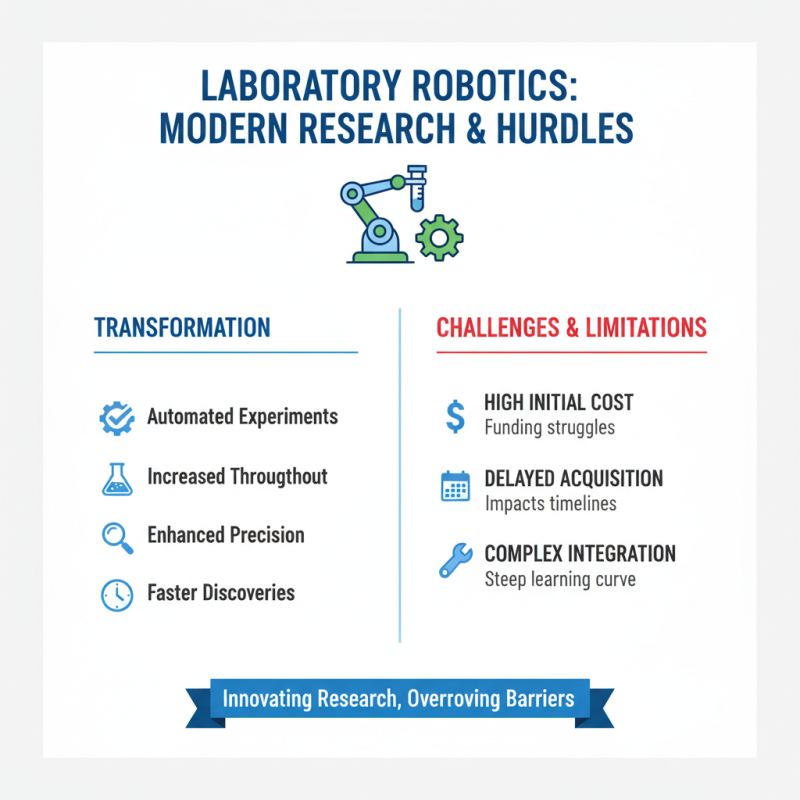
Laboratory robotics has transformed modern research. However, it comes with challenges and limitations. One major hurdle is the high initial cost of robotic systems. Many research institutions struggle to secure funding for these advanced technologies. This can delay the acquisition of robotics, impacting research timelines.
Another challenge involves the integration of robots into existing laboratory workflows. Many scientists are accustomed to traditional methods. The transition to automated processes can be met with resistance. Training staff to operate and maintain robotic systems requires time and resources, which are often in short supply.
Data management presents a significant issue as well. Robotics generate vast amounts of data. Researchers must find ways to store, analyze, and interpret this information. This can overwhelm existing IT infrastructures. Additionally, the complexity of robot programming can lead to errors. These flaws might compromise research integrity or lead to incorrect results. Addressing these limitations is crucial for fully harnessing the potential of laboratory robotics in research.
Future Trends in Laboratory Robotics and Their Impact on Research
The field of laboratory robotics is rapidly evolving. Future trends indicate a significant shift toward more adaptive and intelligent systems. According to a recent report by Research and Markets, the laboratory automation market is projected to reach $6.5 billion by 2026. This growth is driven by the increasing need for efficiency in research processes.
Incorporating artificial intelligence could revolutionize data analysis. Robots that learn from each experiment can optimize workflows and minimize human error. A study in Nature Biotechnology highlights that automated systems improved accuracy by over 30% in complex tasks. However, there is still a challenge in integrating these new technologies seamlessly into existing setups.
Furthermore, while robotics can enhance productivity, they also raise important ethical questions. The reliance on machines could lead to potential job losses. Universities and labs must navigate this shift thoughtfully. Balancing automation benefits with human oversight remains crucial for responsible innovation. This reflection on robotics shows that while they hold promise, careful consideration is necessary to ensure a sustainable future in research.
Impact of Laboratory Robotics on Research Efficiency