Why Is a Roller Compactor Essential for Efficient Production?
A Roller Compactor can make production more consistent by turning fine powders into ribbons or flakes before milling and sizing. The change is visible on the line: powder feeds between two rotating rolls, forms a compacted sheet, then breaks into granules for later processing. This dry process can reduce reliance on liquid binders and drying steps. It may also help stabilize feeding and improve control over granule size. But it is not a shortcut to quality.
Dr. Alexander Kleinebudde is a pharmaceutical technology researcher known for work on roller compaction. A responsible summary of his research perspective—not a verified direct quotation—is that process settings and material properties must be considered together. That matters in practice. Roll pressure, roll speed, feed consistency, and powder behavior can all affect ribbon density and the granules that follow. Small changes may alter performance. Sometimes the results are less tidy than expected.
This introduction examines why a Roller Compactor can support efficient production, where its advantages come from, and which operating factors deserve close attention. Efficiency is not simply faster output. It also means repeatable material flow, manageable downstream milling, and fewer avoidable process adjustments. The best results require testing with the actual formulation and equipment. A compactor can improve a process, but it cannot correct every weakness in one.
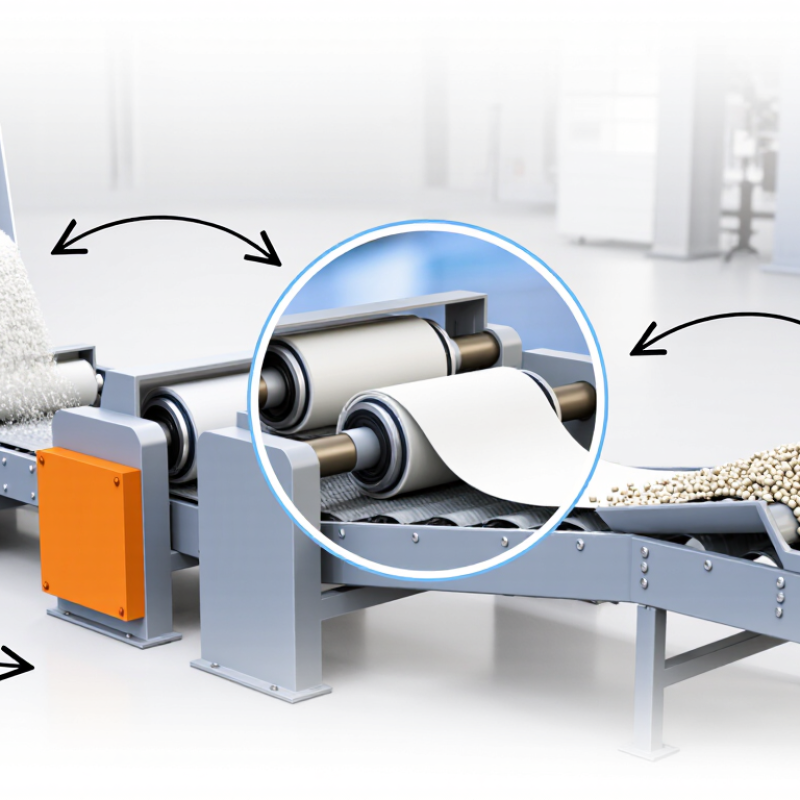
Roller Compaction: A Continuous Dry-Granulation Process for Powder Densification
Why Is a Roller Compactor Essential for Efficient Production?
Roller compaction is a continuous dry-granulation process for powder densification. It converts loose powder into compact ribbons between two counter-rotating rolls. A milling unit then breaks these ribbons into more uniform granules. No liquid binder is required. No drying stage follows.
This process can improve powder flow, bulk density, and feeding consistency. Operators often see less dust around transfer points. The change is especially clear when a light powder previously bridged inside a hopper. A screw feeder supplies the powder at a controlled rate. Roll pressure, roll gap, speed, and milling settings then shape the final granule size.
Small adjustments matter.
Excessive pressure may create overly hard ribbons that mill poorly. Insufficient pressure can produce weak granules and irregular feeding. Practical monitoring should include ribbon appearance, motor load, particle-size distribution, and moisture content. Sampling from the beginning, middle, and end of production can reveal hidden variation.
A roller compactor is not an automatic solution. Powders behave differently, even within the same formulation. Some materials require careful deaeration before compaction. Others may generate too many fines after milling. Experienced operators usually develop a stable operating window through trials, measurement, and gradual adjustment. The process is efficient, but it still needs attention.
Why Is a Roller Compactor Essential for Efficient Production?
Roller compaction is a continuous dry-granulation process that densifies powders without adding liquid binder or requiring a drying step. This can simplify production, reduce thermal exposure, and support steady powder processing.
How Feed, Roll Compression, and Milling Convert Powders into Granules
A roller compactor converts powder into granules through three linked steps: controlled feeding, roll compression, and milling. Feed screws deliver powder evenly to the rolls; uneven feeding can create ribbons with inconsistent density. Under pressure, the powder forms a compact ribbon without liquid binder. Kleinebudde’s review of pharmaceutical roller compaction describes how material properties and operating conditions influence ribbon formation and downstream granule quality. The ribbon is then milled, producing particles suited to handling and further processing. Small changes matter.
Compression force, roll gap, and feed rate interact. A dense ribbon may resist milling and produce excess fines, while a weak ribbon can break apart too easily. The useful operating window depends on the powder, so fixed settings do not guarantee repeatable results. The FDA’s 2011 Process Validation guidance defines three lifecycle stages: process design, qualification, and continued process verification. Applied here, that means checking feed consistency, ribbon density, and granule-size distribution across production—not just during setup. Operators can compare samples from different points in a run. A few measurements may still miss local variation.
Tips: Track roll force and ribbon appearance together. Record the settings when granules become dusty or unusually coarse; those notes can reveal patterns, though they are not a substitute for testing.
Key Operating Measures: Specific Force (kN/cm), Roll Gap (mm), and Speed (rpm)
Why Is a Roller Compactor Essential for Efficient Production?
Specific force, roll gap, and roll speed control the quality of dry granules. Published studies in AAPS PharmSciTech commonly evaluate specific forces from 2 to 10 kN/cm. Higher force usually increases ribbon density, but excessive pressure can create hard granules and slower dissolution. A practical starting point is 4–6 kN/cm, followed by testing. The gap often stays near 1–3 mm. A narrower gap may improve densification, yet it can increase torque and material stress. Roll speed commonly ranges from 2–10 rpm. Faster rolls raise throughput, but reduce powder residence time. The result may be weaker ribbons. Small changes matter.
A 2023 review in International Journal of Pharmaceutics emphasizes linking compaction settings with ribbon density, granule size, and tablet tensile strength. FDA Process Validation guidance also supports continued process verification, not one-time approval. Measure force, gap, speed, feeder load, and product moisture together. One parameter rarely explains the whole result. In my experience, operators often trust the displayed force too quickly. Load-cell calibration and powder feeding stability deserve equal attention. A fixed recipe can mislead.
Tips: Begin with a designed experiment, not guesswork. Hold two settings steady while changing one variable. Check ribbon appearance every few minutes. Record edge cracking, dust, and roll buildup. If results drift, inspect moisture and feed consistency before increasing force. ICH Q8(R2) recommends defining a science-based design space, although real production still demands practical adjustment.
Typical Specific Compaction Forces Range from 2 to 20 kN/cm, Depending on Material
Why Is a Roller Compactor Essential for Efficient Production?
Typical specific compaction forces range from 2 to 20 kN/cm, depending on material. This range matters because powders respond differently under pressure. A cohesive pharmaceutical blend may compact at 4 kN/cm, while a weak, porous mineral blend may need 15 kN/cm or more. Peer-reviewed reviews in Powder Technology report that roll force, gap, moisture, and particle size strongly influence ribbon density and strength. The European Medicines Agency also emphasizes process understanding and consistent critical parameters in continuous manufacturing.
In production, a roller compactor can reduce dust, improve material flow, and create a more stable feed for milling or tableting. However, higher force is not automatically better. Excessive force may produce dense ribbons that mill poorly or dissolve too slowly. Plant trials often show a practical compromise: stable throughput, controlled ribbon density, and acceptable granule size. It is not always perfect. Small moisture changes can shift the result.
Tips: Start near the lower force range, then increase gradually. Measure ribbon density, granule-size distribution, and moisture after each adjustment. Keep roll speed and gap recorded. A 2023 review in International Journal of Pharmaceutics notes that scale-up can change stress distribution, so laboratory settings should not be copied blindly. Simple records prevent expensive assumptions.
Efficiency Gains and Trade-Offs in Pharmaceutical and Industrial Production
A roller compactor can improve production by turning powder into ribbons that are milled into granules. In pharmaceutical manufacturing, this dry process can reduce reliance on liquid binders and avoid a separate drying step. Fewer transfers may also mean less dust around feeders and collection points. Small gains add up.
The benefits depend on the material. Operators can adjust roll force, gap, and feed rate, then check ribbon density and granule size. A steady feed may support consistent downstream flow, but excessive force can create hard ribbons that mill poorly. Some blends also separate or produce too many fines. Not every material cooperates.
Industrial plants may value higher throughput and fewer wet-process steps, especially when drying capacity limits a line. Yet a compactor adds its own demands: rolls and screens wear, cleaning takes time, and product changeovers need careful control. Pharmaceutical teams must also document process settings and confirm that granules meet quality specifications. I have seen efficiency estimates look convincing on paper, then narrow after maintenance and cleaning time are included. Pilot trials, with realistic feed rates and sampling, help reveal that gap before a larger investment.