

10 Best Robotics Lab Equipment Suppliers Worldwide
A well-equipped robotics lab depends on more than a robot arm. It needs compatible sensors, grippers, motion controllers, workbenches, safety enclosures, and software. Small details matter. A connector that does not match or a delayed replacement part can interrupt a carefully planned experiment. Choosing a supplier is therefore a technical decision, not just a purchasing task.
This guide introduces ten robotics lab equipment suppliers serving customers in different regions and at different stages of development. Their offerings should be assessed against practical needs: equipment specifications, system compatibility, documentation, training, spare-part availability, and responsive technical support. For example, a research team building mobile robots may value compact sensors and flexible development tools, while an automation course may need durable equipment and clear setup guidance. No supplier fits every lab. Prices, delivery times, and service coverage can also vary by location, so readers should confirm current details directly with vendors. A polished product page is helpful, but it cannot replace checking specifications and asking how the equipment will integrate with existing systems. The comparisons ahead offer a starting point—not a substitute for careful evaluation.
What Robotics Lab Equipment Includes
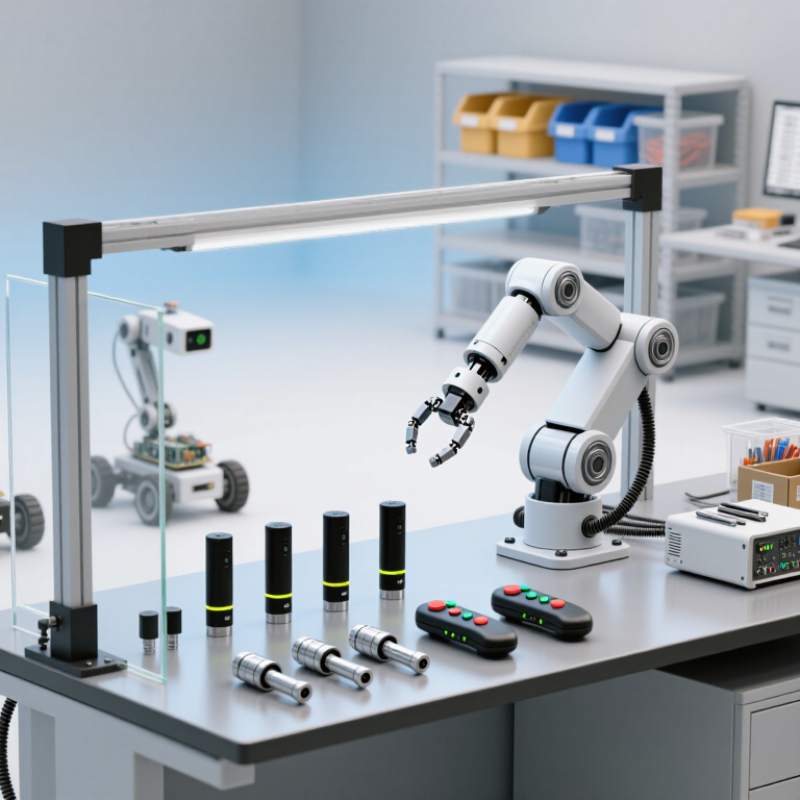
Robotics lab equipment includes far more than robot arms. A complete setup may contain mobile platforms, grippers, vision cameras, force sensors, controllers, workbenches, and protective enclosures. It also includes software for programming, simulation, and data logging. Each component supports a different part of testing, from guiding a tool to measuring its contact with an object.
The right equipment depends on the work. A small research cell might need a compact arm, a sturdy table, and cameras with clear views of the workspace. A mobile robotics project may require floor markers, charging stations, and tools for recording sensor data. Check payload, reach, repeatability, and compatibility before purchasing. Ask how calibration is performed and how replacement parts are handled. A neat specification sheet does not show every setup challenge. Cable routing, glare, and vibration can disrupt results, even in a well-equipped lab. Some details are easy to overlook.
Tips: Measure the work area before ordering. Leave space for cables and maintenance access. Test sensors under real lighting conditions. Keep a simple inventory of adapters and spare fasteners; missing small parts can delay a session. No setup is perfect, so record what needs adjustment.
10 Best Robotics Lab Equipment Suppliers Worldwide - What Robotics Lab Equipment Includes
Robotics lab equipment spans robot platforms, sensing, tooling, safety, and fabrication. This overview describes common equipment categories and practical comparison points; specifications vary by model and application.
| # | Equipment Category | What It Includes | Key Specifications to Compare | Common Lab Applications |
|---|---|---|---|---|
| 1 | Industrial and Collaborative Robot Arms | Articulated, SCARA, or Cartesian robot arms, typically supplied with a controller, teach pendant, and installation documentation. | Degrees of freedom, payload, reach, repeatability, mounting options, programming interfaces, and safety functions. | Pick-and-place, assembly, machine tending, research on manipulation, and automated laboratory tasks. |
| 2 | Mobile Robot Platforms | Wheeled or tracked bases with drive motors, onboard control, power systems, and mounting points for sensors or manipulators. | Payload capacity, footprint, wheel configuration, runtime, localization support, communication interfaces, and indoor or outdoor suitability. | Autonomous navigation, warehouse research, inspection, mapping, and mobile manipulation. |
| 3 | End Effectors and Grippers | Two-finger or multi-finger grippers, vacuum tools, tool changers, and task-specific attachment hardware. | Jaw opening, gripping force, payload, finger design, actuation method, sensing options, and compatibility with the robot flange. | Object handling, bin picking, assembly, packaging, and experiments in grasp planning. |
| 4 | Machine-Vision Cameras and 3D Sensors | 2D industrial cameras, depth cameras, stereo cameras, lenses, lighting, and image-acquisition interfaces. | Resolution, frame rate, field of view, working distance, depth method, interface, lighting needs, and calibration support. | Object recognition, part localization, visual inspection, pose estimation, and robot guidance. |
| 5 | Force/Torque and Tactile Sensors | Wrist-mounted force/torque sensors, tactile arrays, and associated signal-conditioning or data-acquisition hardware. | Measurement axes, range, resolution, overload capacity, sampling rate, mounting pattern, and interface compatibility. | Compliant manipulation, contact detection, insertion, polishing, and force-controlled assembly. |
| 6 | Motion-Capture and Position-Tracking Systems | Optical cameras or other tracking sensors, reflective markers or rigid bodies, and software for position and orientation data. | Tracking volume, number of tracked objects, update rate, accuracy, line-of-sight requirements, and data-output options. | Robot and human motion analysis, ground-truth positioning, biomechanics, and validation of navigation or tracking algorithms. |
| 7 | Robot Controllers and Real-Time Computing | Robot control units, industrial PCs, embedded computers, input/output modules, and networking hardware. | Supported robot interfaces, processor capability, real-time support, communication protocols, I/O capacity, and software compatibility. | Motion control, sensor integration, data processing, simulation, and coordination of multiple devices. |
| 8 | Safety Equipment and Workcells | Perimeter guarding, interlocked doors, emergency-stop devices, safety-rated scanners, and robot-cell fixtures. | Risk assessment requirements, safety ratings, stopping-distance considerations, access needs, and integration with robot safety functions. | Creating controlled research and teaching workspaces for robot operation and human-robot interaction. |
| 9 | Rapid-Prototyping Equipment | 3D printers, filament or resin systems, post-processing tools, and basic workshop equipment for fixtures and prototypes. | Build volume, material compatibility, dimensional capability, workflow requirements, ventilation, and maintenance needs. | Producing gripper fingers, sensor mounts, robot-cell fixtures, and experimental prototypes. |
| 10 | Calibration and Metrology Tools | Calibration targets, measurement instruments, alignment tools, and software used to check sensor and robot coordinate systems. | Measurement range, resolution, calibration procedure, traceability documentation, and compatibility with the equipment being checked. | Camera calibration, tool-center-point setup, coordinate-frame alignment, and repeatability or accuracy verification. |
Related Posts
-
China Top Robotics Lab Manufacturers for Global Buyers
-

10 Unmatched Robotics Innovations You Should Think About
-
What is a Robotics Lab and Its Importance in Technology?
-
How to Choose the Best Warehouse Robotics for Your Needs?
-
What Are the Top Agile Robotics Companies in China?
-
China Top 10 Robotics Products Suppliers for Global Buyers